
I’ve looked into this because I think it’s a really important question for The DIY Business Club, especially for people who are starting businesses alone, without investors, a team or a financial safety net.
And I want to give you an honest answer, not the usual social media advice that says, “Just follow your passion, work hard and the money will come!”
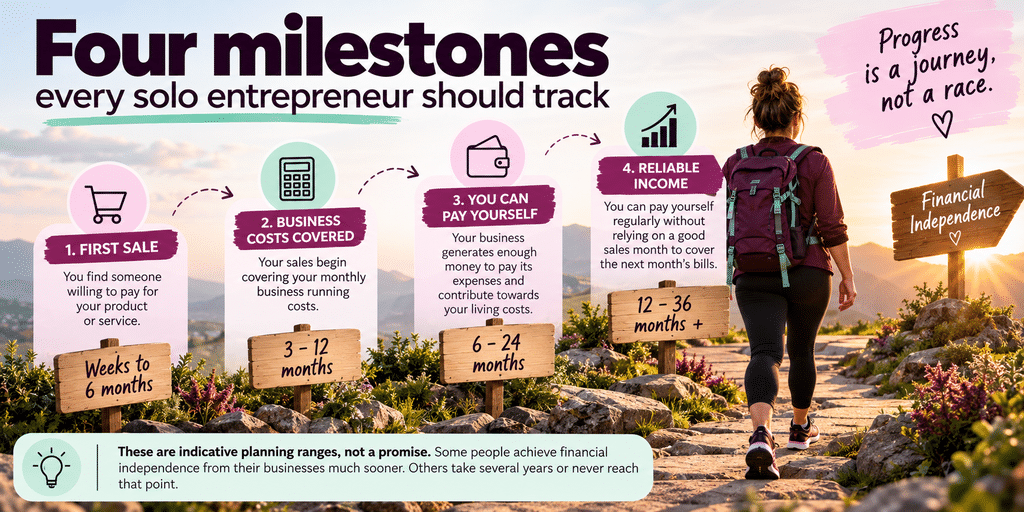
Making your first sale, covering your business expenses, and earning enough to support yourself are three very different milestones.
For a one-person business, that distinction matters enormously.
1. How long does it take for a solo business to make enough money?
The short answer
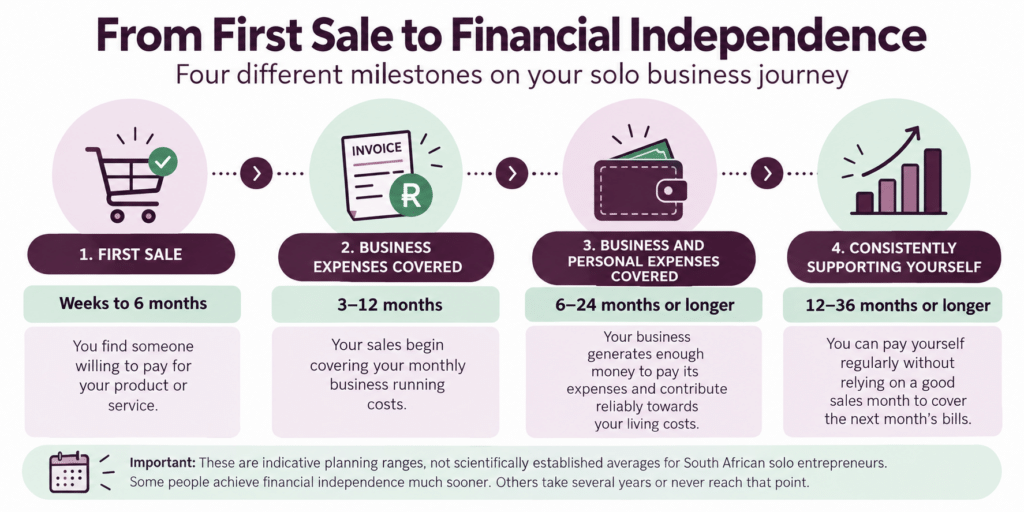
For planning purposes, I would use the following timeline for someone starting a small, owner-operated business from scratch.
| Stage | Indicative timeframe | What it means |
|---|---|---|
| First sale | Weeks to 6 months | You find someone willing to pay for your product or service. |
| Covering business expenses | 3–12 months | Your sales begin covering your monthly business running costs. |
| Covering business costs AND basic personal expenses | 6–24 months or longer | Your business generates enough money to pay its expenses and contribute reliably towards your living costs. |
| Consistently supporting yourself | 12–36 months or longer | You can pay yourself regularly without relying on a good sales month to cover the next month’s bills. |
Important: These are indicative planning ranges, not scientifically established averages for South African solo entrepreneurs. I could not find a reliable, representative study that establishes exactly how many months a one-person business takes to generate enough income to cover both personal living expenses and business costs.
The timeframes above are a practical planning framework, not a promise. Some people achieve financial independence from their businesses much sooner. Others take several years or never reach that point.
Let’s look at what the research actually tells us.
2. What does the research say?
Research finding 1: Breaking even can take longer than a year.

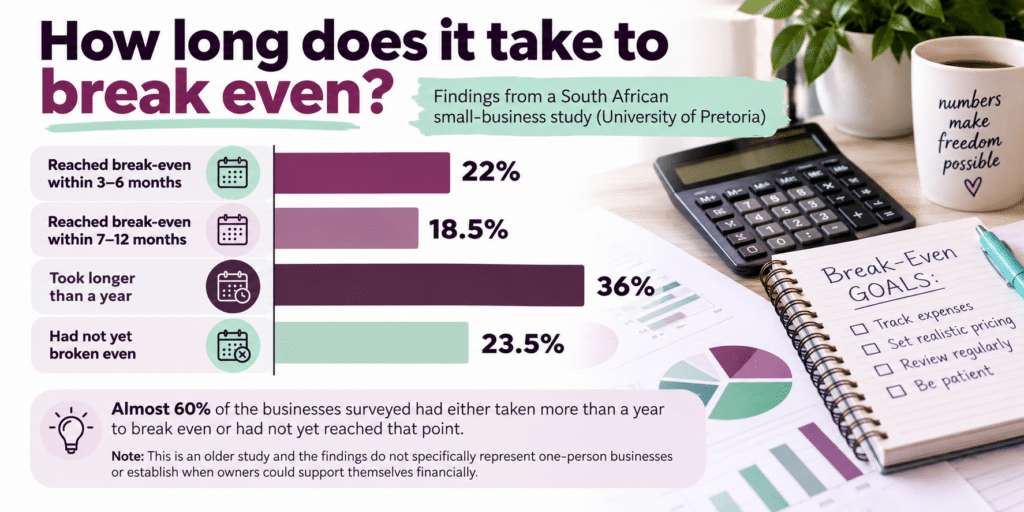
A South African small-business study published through the University of Pretoria examined how long businesses took to break even.
The findings were:
- 22% reached break-even within 3–6 months.
- 18.5% reached break-even within 7–12 months.
- 36% took longer than a year.
- 23.5% had not yet broken even when surveyed.
That means almost 60% of the businesses surveyed had either taken more than a year to break even or had not yet reached that point.
However, there is an important limitation: this is an older study, and the findings do not specifically represent one-person businesses or establish when owners could support themselves financially.
Nevertheless, it challenges the idea that every business should be profitable within a few months.
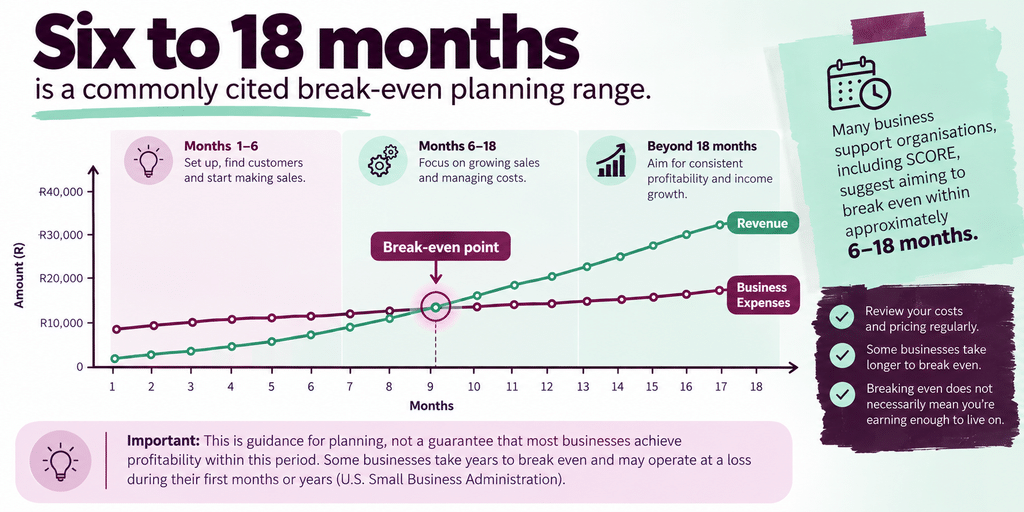
Research finding 2: Six to 18 months is a commonly cited break-even planning range.
The US-based nonprofit business support organisation SCORE suggests aiming to break even within approximately 6–18 months.
It also recommends reviewing costs and pricing if the break-even calculation suggests that it will take substantially longer. This is guidance for planning, rather than a guarantee that businesses generally achieve profitability within that period.
The U.S. Small Business Administration also explains that some businesses take years to break even, potentially operating at a loss during their first months or years.
And remember: breaking even does not necessarily mean the owner is earning enough to live on.
A business could cover its software, internet, marketing and other operating expenses while leaving its owner with very little money.
Research finding 3: Having a business does not guarantee having an income.
South Africa’s informal-business sector illustrates this problem.
Statistics South Africa’s 2013 Survey of Employers and the Self-Employed found that more than half of the informal businesses surveyed had turnover of R1,500 or less in the preceding month, and fewer than 10% reported net profits exceeding R6,000.
Those figures are old and relate to informal businesses, so they should not be treated as current income estimates for all South African entrepreneurs.
However, they demonstrate an important distinction: operating a business and generating enough income to live on are not the same thing.
The more recent FinMark Trust FinScope MSME South Africa 2024 findings also highlight the scale and diversity of South Africa’s micro-enterprise sector, including the significant number of businesses operating informally. The report notes that financial and structural challenges continue to affect these businesses.
My conclusion from the research: There is no defensible universal average for when a solo founder becomes financially self-sufficient. A business plan should allow for the possibility that it will take a year or longer, rather than assuming the owner will be earning a full living within three months.
3. The biggest mistake: confusing turnover with income
Let’s imagine someone starts a small graphic design and social media business.
They have a good month and bring in R15,000.
It feels like progress. But look at what happens when the money is allocated.
| Monthly item | Amount |
|---|---|
| Revenue received | R15,000 |
| Software and subscriptions | -R1,000 |
| Internet and phone | -R800 |
| Marketing and advertising | -R1,000 |
| Other business expenses | -R700 |
| Money remaining before tax and owner pay | R11,500 |
The owner hasn’t earned R15,000 personally.
They have R11,500 remaining before tax, any additional business costs, and their personal living expenses.
If they need R10,000 to cover their household expenses, they have only R1,500 left before accounting for those other obligations.
And if the next month brings in only R8,000, the situation changes again.
This is why a business can look successful from the outside while its owner is still struggling to pay their bills.
4. How much must a solo business actually earn?
The answer depends on the owner’s lifestyle, business model and operating costs.
Let’s use an illustrative South African example.
Suppose a person needs the following each month:
| Expense | Monthly amount |
|---|---|
| Basic personal living expenses | R12,000 |
| Business running costs | R3,000 |
| Minimum required before tax and additional provisions | R15,000 |
The business needs to generate enough money to cover both sets of expenses.
But R15,000 in revenue is not necessarily enough.
The owner may also need to account for:
- Tax obligations.
- Payment-processing fees and other variable costs.
- Annual expenses that don’t arrive every month.
- Emergency savings and slow periods.
- Money reinvested into the business.
The actual revenue target will therefore depend on the business’s margins and tax position.
The South African government recommends including a financial plan in your business plan, with calculations for break-even, monthly cash requirements and funding sources.
The important lesson is to calculate the income you need first, rather than deciding that a particular turnover figure means you’ve made it.
5. Why does it take longer when you’re running everything yourself?

When you’re a solo entrepreneur, you’re responsible for more than delivering your product or service.
You’re also the salesperson, marketer, administrator, bookkeeper and customer service department.
That creates several challenges.
1. You have limited billable hours.
You cannot spend every working hour earning money. You need time to find customers, prepare quotes, send invoices, market the business and manage administration.
2. You start without predictable income.
You may earn R20,000 one month and R6,000 the next. Your household expenses, however, continue regardless.
3. You may undercharge.
New business owners sometimes price their services based on what they think customers will pay without calculating their expenses, working hours and required income.
4. You may not have enough customers yet.
Even if your service is excellent, people need to discover your business, trust you and decide to buy.
5. You’re building the business while running it.
You need to deliver today’s work while also creating the systems, marketing and customer pipeline that will help you earn money next month.
This is why a realistic financial plan needs to account for the time spent on activities that do not generate immediate revenue.
6. What timeline should a new business owner plan for?
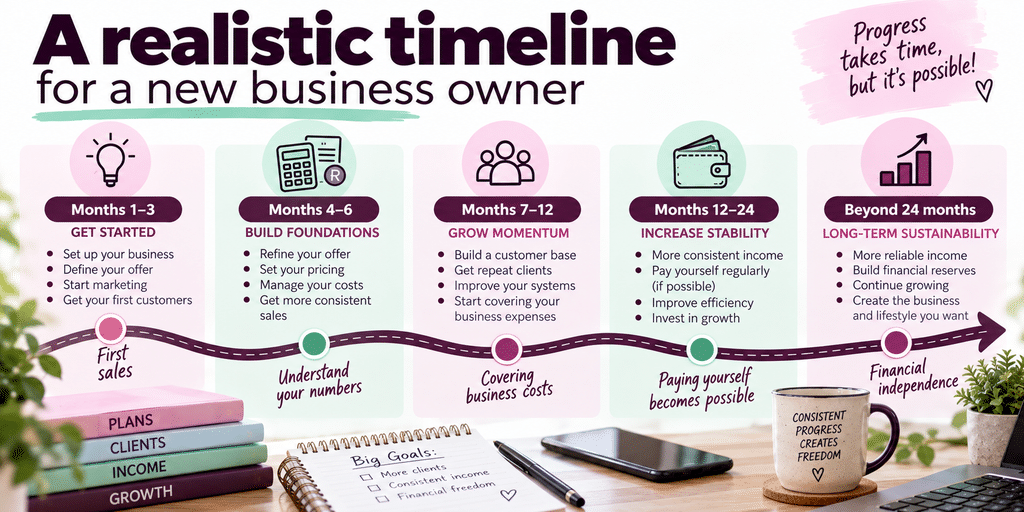
For The DIY Business Club, I would communicate the following expectations to people starting their own businesses.
| Period | Practical focus |
|---|---|
| Months 1–3 | Validate the idea, find potential customers, make initial sales and understand your costs. |
| Months 4–6 | Improve your offer, pricing and marketing. Work towards covering your business expenses consistently. |
| Months 7–12 | Build repeat business, strengthen your customer pipeline and work towards paying yourself more regularly. |
| Months 12–24 | Aim for more consistent income that covers business costs and personal living expenses. Review whether the business model is financially sustainable. |
| Beyond 24 months | Continue improving profitability, building financial reserves and reducing dependence on unpredictable sales. |
These are suggested milestones, not research-established averages or deadlines. A service provider with an existing network and paying clients could progress much faster than someone developing a new product without an established audience.
A business selling low-cost products may also need many more transactions than a service provider selling higher-value work.
The goal is not to force every business into the same timeline. It is to help owners understand what they need to achieve at each stage.
7. My biggest recommendation for solo entrepreneurs
Don’t use your first sale as the measure of success.
Use these four milestones instead:
Milestone 1: Someone pays you.
You’ve demonstrated that at least one customer is willing to buy.
Milestone 2: Your business covers its own costs.
You are no longer relying on personal money to fund routine business expenses.
Milestone 3: Your business pays you.
You can withdraw money for personal expenses without leaving essential business bills unpaid.
Milestone 4: Your income becomes reliable.
You can cover your personal expenses, business costs and financial provisions consistently, including during slower months.
The fourth milestone is the one that matters most when deciding whether your business can support your lifestyle.
And remember: you don’t have to reach it immediately for your business to be worth pursuing. You do, however, need to know where you stand financially.
What I would teach inside The DIY Business Club
I would turn this research into a resource called:
“How Long Until My Business Can Pay Me? A Realistic Financial Roadmap for Solo Entrepreneurs.”
It could help new business owners calculate:
- Their minimum monthly personal living expenses.
- Their monthly business operating costs.
- The revenue they need to generate.
- How many products or services they need to sell.
- How much they need to charge.
- How much money they should keep aside for tax and slower months.
- Whether their current business model can realistically support their desired lifestyle.
That would be more useful than simply telling people to expect to be profitable within six months.
The message I would want every new entrepreneur to understand is this:
You can build a successful business, but you need to give yourself realistic expectations, understand your numbers and plan for the period before the business can support you.
Your business doesn’t have to make you financially independent overnight. It does need a plan for getting there.
And the sooner you understand the numbers, the sooner you can make informed decisions about your future. 💚